
NDBIN Newsletter – Winter 2025
National Association of State Head Injury Administrators State of the State Conference
The North Dakota Brain Injury Network (NDBIN) headed to the coast to Portland, Maine for the National Association of State Head Injury Administrator's (NASHIA) annual State of the State (SOS) Conference this year. In addition to eating a lot of seafood and visiting lighthouses, our Director Rebecca Quinn was honored with the Friend of NASHIA award. See what NASHIA wrote about Rebecca:
"The Friend of NASHIA award is being given to an exceptional leader whose vision and collaboration have transformed how North Dakota supports people with brain injury and their caregivers.
Rebecca Quinn is a true systems builder. She forges partnerships across agencies, communities, and disciplines to create coordinated, person-centered services that truly change lives. Working closely with NASHIA, she has advanced best practices for her state's Advisory Council on Brain Injury, shaped a strong State Plan, and has been a tireless advocate for paid peer supports.
Known for her deep expertise and generous spirit, Rebecca shares her knowledge with other states to help them think through how all of the pieces of complex systems connect. Her big-picture thinking has strengthened services across rural areas and expanded access to care for Medicaid beneficiaries. Rebecca helped design one of the nation's only Medicaid programs that specifically recognizes brain injury within behavioral health – a groundbreaking achievement that has strengthened care statewide.
She also leverages policy to create lasting impact – including ensuring that brain injury is formally recognized within North Dakota's Certified Peer Support Specialist framework, opening new opportunities for people with lived experience to lead and support others.
Her partnerships now extend from youth programs to prisons and domestic violence services, making brain injury screening a recognized and supported part of her state's work.
Rebecca Quinn embodies the spirit of the Friend of NASHIA Award – she's smart, collaborative, and deeply committed to improving lives. She is building a stronger, more inclusive system in North Dakota and beyond."
NDBIN is very excited to bring back valuable information learned at the SOS conference and continue to make headway on improving brain injury care in our state!
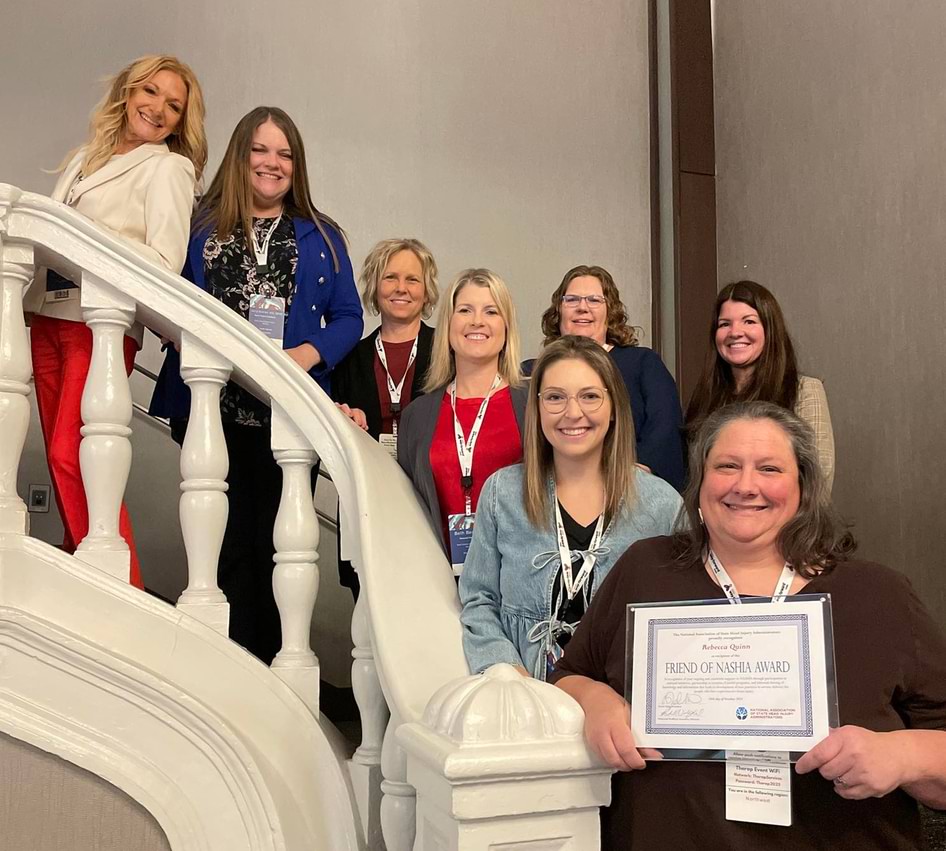 Top left to bottom right: Shannan Stanke, Carly Endres, Tami Conrad, Beth
Beckers, Nickie Livedalen, Jessica Siefken, Andrea Sailer, Rebecca Quinn
Top left to bottom right: Shannan Stanke, Carly Endres, Tami Conrad, Beth
Beckers, Nickie Livedalen, Jessica Siefken, Andrea Sailer, Rebecca Quinn
Thriving During the Holidays
By Andrea Sailer

With the holidays upon us, many brain injury survivors will find themselves facing more overstimulation than normal. This extra stimulation can cause additional brain fatigue and stress, and in some situations, both fear and panic may set in.
Overstimulation is one of the most common effects of brain injury, and it can be caused by any combination of sounds, images, light, emotions, smell, taste, and touch. Because overstimulation can't be seen, it can be a mystery to those who have never experienced it.
Here are some holiday tips to help you get through the celebration while still prioritizing your health and needs! NOTE: It's important to listen to your body and rest when rest is needed.
Keep unnecessary stimulation to a minimum. Decrease the amount of stimulation in places where you have control. If you know you're headed to a mall, crowded restaurant, or busy house, don't watch television before heading out or listening to the radio on the way there to preserve your "brain power" for stimulating events. If you are going to a friend's or family's house, have a planned 'getaway' location (like a bedroom, bathroom, basement) available to get away for breaks while you're there.
Get additional rest. While this one seems obvious, it is sometimes hard to do with the hustle and bustle of the holiday season. Rest is critical to help your brain recover from overstimulation. Take a nap before or after your outing and do your best to get a good night's sleep each night. Avoid caffeine too late into the day. Give yourself a designated bedtime, and stick with a schedule throughout the holidays.
Take shorter trips. If you have a lot to do, you may want to consider breaking it up into smaller trips. It will be easier to do one errand each day rather than trying to cram five things into one outing. It may take longer, but your brain will thank you!
Write lists (to-do, grocery, schedules). Sticky notes and shopping lists are going to be your best friend. Having a plan that details exactly where you need to go and what you need to purchase at each location will help you keep your stress levels down and keep you organized.
Ask for help. It can be hard to do, but sometimes you need to ask for help – whether it's asking for someone to drive you somewhere, carry your bags, or even run an errand for you.
Stay hydrated. The brain functions best when it is fully hydrated. When you are out shopping or cooking a large meal, it is easy to become dehydrated. Do your best to keep a water bottle near you all day long and set reminders/alarms so you remember to drink water. As tempting as it is, drinking alcohol and caffeine will cause you to become dehydrated, so it is best to avoid these drinks when you know you are going to be faced with overstimulation.
Prepare ahead of time. Make lists (grocery, to-do). Run errands early on. Make freezer meals. Space out everything you want to do, like cleaning or shopping. That way, you don't feel rushed and have plenty of time to do things at your own speed. It's also wise to give yourself a day of rest before any celebration.
Set boundaries if needed. Setting boundaries is important for your mental health during the holidays. Whether that means delegating responsibilities or stepping away from the chaos for a moment, sometimes you must set boundaries. It might be difficult at first to set boundaries with a family member or a friend, but this will help loved ones understand what's best for you and end better for everyone in the long run! They should know that with a traumatic brain injury (TBI), holidays can require parameters in your social life. And this allows you to be at your best when you're with them.
Don't overexert yourself. When you're a TBI survivor, fatigue can be a constant struggle. Holiday parties and celebrations often run for many hours, and you may become tired easily. Monitor your energy levels and take breaks or leave when needed.
Undertake reasonable tasks. Everyone has identifiable strengths and weaknesses. Find things you can do yourself and designate people to help you. Injury or no injury, working together on holiday celebrations brings family members together. You can have a joyful opportunity to bond.
NDBIN's Newest Member!
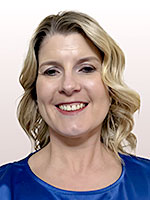
Beth Beckers joined NDBIN in September 2025 as our newest resource facilitator. Beth says, "I'm ready for the challenge of providing specialized support for brain injury survivors through the Center for Rural Health (CRH). It's a privilege to help bridge the gap in care, and I'm excited to bring my personal touch." Before joining CRH, Beth worked at Bismarck State College as an academic advisor, as well as at Martin Luther School in Bismarck teaching grades 7-8 and as a marketing manager. Originally from Devils Lake, North Dakota, Beth earned a bachelor's in family consumer sciences education at North Dakota State University and a master's in teaching and technology at Valley City State University.
In addition to being a great addition to NDBIN, Beth is also a brain injury survivor. Beth sustained a brain injury in 2003 during a three-wheeler accident. After being airlifted to Sanford Health in Fargo, she was in a drug induced coma for three days and benefited from inpatient and outpatient therapy (OT, PT, SLP). See some of the insight that Beth will be bringing to NDBIN from a survivor's lens:
How has your life changed? Is it better? Is it worse?
Better and worse! I have learned to appreciate each day. It was tough learning to walk and regaining my
cognitive functioning and short-term memory. My recovery taught me that I can do tough things if I stick to
it. It has been a challenge, learning how to use the accommodations that I need and to be different from
other people. I never wanted anyone to know that I had a BI and that I couldn't do things the same as other
people.
What do you miss the most from your pre-brain injury life?
Earlier on with my recovery, I missed my whole package (what I used to be). I didn't like the idea that I
had a brain injury (BI) and I needed to do things differently (I hated the idea that I needed to nap every
day). I also hated to be in the wheelchair, use the walker, or cane. I learned to walk as fast as I could!
Now, I can't really remember what life was like before my injury because it happened 22 years ago. I have
grown up a lot and am in a different stage of life now.
What do you enjoy most in your post-brain injury life?
I have just started using my BI in a positive way. I am not afraid to tell people about it anymore. I have
found that BI is much more common than I thought. I hope that I can help people through the experiences I
have lived through. Since my accident, I have this feeling that I need to work with people who have BI. I
never knew what that meant, especially since I went into education and have done many different jobs and
activities with education.
What do you like least about your brain injury?
Right away, I didn't like the idea that I had a BI. Everything was challenging and different from everyone
else. I am so thankful that I kept working through those challenges and just put my head down and tried to
blend in. My close family and I knew I had challenges, but I didn't want others to know. Over the last five
years or so, I have learned to appreciate my BI. I have had to do a lot of work to get to that point. The
best thing I did to start embracing my injury was trauma therapy. That helped me look at the difficult
experiences, like being in a wheelchair around young people I knew when I was 18 after my accident. I will
never forget the experience, but I see it in a different perspective now.
What are your plans? What do you expect/hope to be doing 10 years from now?
Working at NDBIN and helping as many people as I can. I am so excited and blessed to be working with the
NDBIN team and I have finally found my "spot" that I have been working and searching for since my accident.
I now know why I had the experiences I have had to go through…I can help people who are experiencing
the same thing I did and still do!
2026 Mind Matters Conference
NDBIN is hosting the annual Mind Matters Conference on March 26-27, 2026, at the Hilton Garden Inn in Fargo, North Dakota. This two-day conference is for individuals with brain injury, family members, caregivers, and professionals. It highlights new research, trends, practice strategies, and collaborative models of care. Innovative approaches and new systems of care for individuals living with brain injury will be presented.
 NDBIN is hosting the annual
 Happy Holidays!
As always, NDBIN is here to support you! Whether you are a survivor, family member, or professional – reach out if you need additional ideas or brain injury support!